IMPRINT
Cryptographic provenance protection for artists, creators of sound and music producers
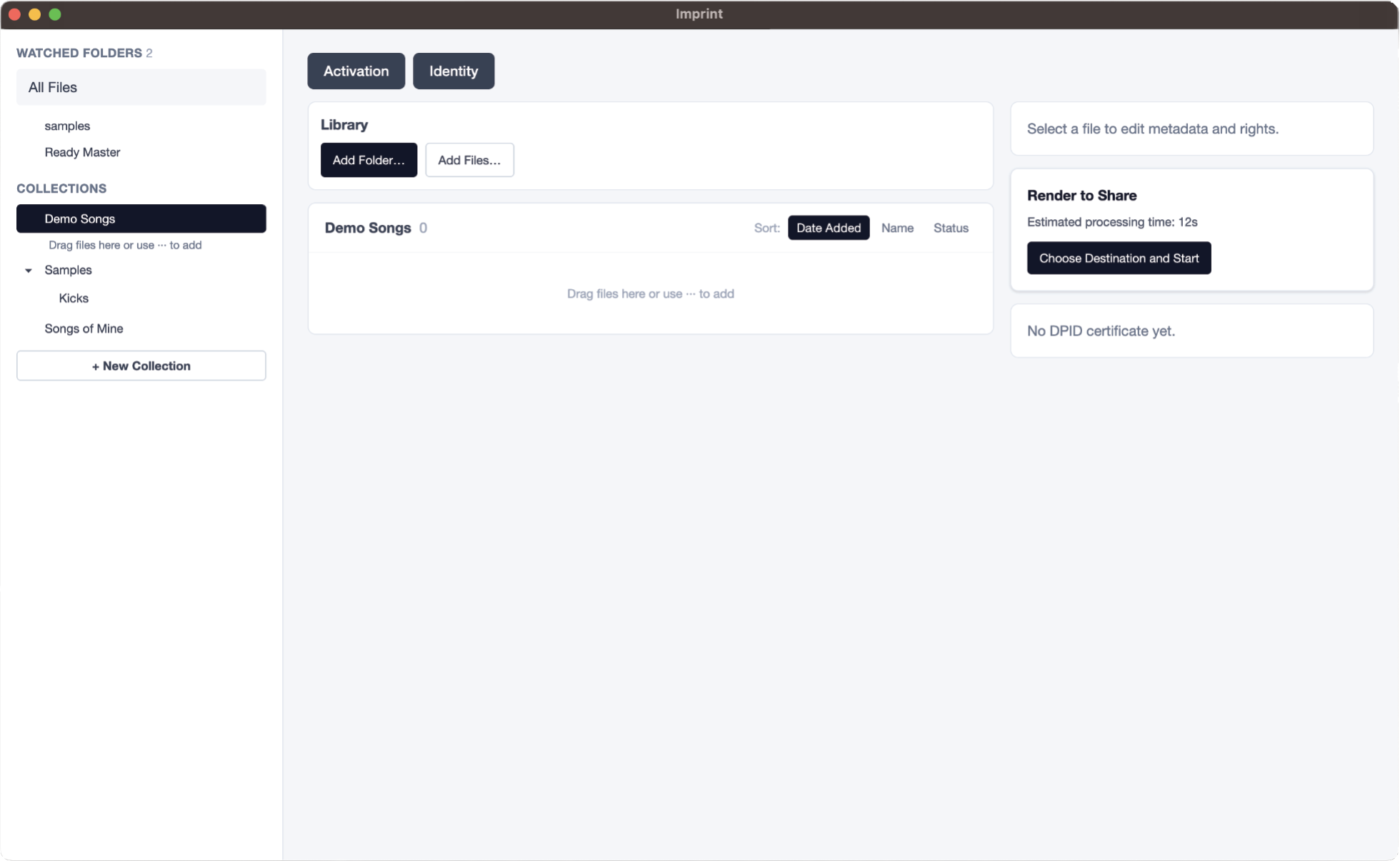
TABLE OF CONTENTS
Imprint is a local-first tool for creating a verifiable provenance trail around unfinished music.
It is for music producers who need to share demos, rough mixes, and early works without handing over the entire burden of proof to a platform, a public ledger, or a legal process after the fact.
It is for artists who want to feel safer and more in control of their work when sharing their creative process through online media platforms.
Imprint does not claim to prove ownership in a final legal sense. It creates a traceable record that can support the artist's standing before formal registration, while the work is still in motion.
The exposure is not only piracy. It is the gap between creation and proof.
Copyright exists from the moment a work is created. But in practice, the creator does not have the official proof of authorship before formal registration with a Performing Rights Organization (PRO).
The critical phase is the one between completion and formal registration. During that time, a demo can circulate, be ingested by others, or be taken into systems that do not keep a clear record of who made it and when.
With Artificial Intelligence on the rise, this problem has become more visible. The music industry is increasingly confronting systems and models that process audio without transparent provenance or consent. Cases involving AI-generated content have shown how quickly the legal and commercial ground can move around creative work. For independent artists and music producers, this is not a niche issue. It is a direct question of traceability and artistic ownership.
The process is designed to be simple.
- 01. Select the work. The user chooses an audio file or folder to protect.
- 02. Create a fingerprint. The user derives a unique identity for the audio content using Imprint.
- 03. Generate a provenance record. A signed certificate records who claimed the material and when it was created.
- 04. Add a watermark (optional). A hidden, content-level mark can be embedded in the file without changing the visible metadata story.
- 05. Timestamp (optional). If needed, a hash can be sent to OpenTimestamps for independent cryptographic time verification.
- 06. Metadata. Rights, authorship, copyright and AI opt-out information are embedded in the file and travel with it.
The certificate is the evidence layer.
DPID certificate
The DPID is a signed Demo Provenance and Identity Document. It captures the claim that the material belongs to a creator at a point in time.
Producer identity — Ed25519 DID
The producer identity can be represented as an Ed25519 DID key pair, allowing cryptographic attestation without depending on a centralized system.
Certificate content
The record contains the originating file identity, claims associated with the work, timestamps, and other data needed to preserve the context of creation.
OpenTimestamps (optional)
When used, OpenTimestamps provides an external proof that a hash existed at a specific moment in time, independent of the local system.
The system is built around restraint and clarity.
- Protection without permanence. Imprint provides evidence at the right moment, not an irreversible public claim.
- Local-first architecture. The work stays on the creator's machine. No audio is uploaded to a cloud workflow by default.
- Two separate layers. The workspace layer handles the creator's files and local identity, while the traceability layer records the signed evidence.
- What Imprint is not. It is not a rights society, not a public blockchain solution, not a legal court ruling, and not a cloud service that moves the work off the machine.
Imprint tries to change the baseline for unfinished work.
What we are trying to change is not the entire rights system. It is the default practice around unfinished music: the idea that a demo can be circulated without any durable, cryptographic trace.
Imprint fills a practical space. It sits between formal registration and everyday file-sharing. It creates a local tool for protection and evidence without making the work into a permanent public verdict.
Status and availability are deliberately limited. This is an early-stage proof-of-concept product designed for a defined group of producers and test users. The point is to establish a credible layer of provenance before the work enters wider distribution.